🕒Download Desperate Remedies: Psychiatry’s Turbulent Quest to Cure Mental Illness by Andrew Scull
Desperate Remedies: Psychiatry’s Turbulent Quest to Cure Mental Illness by Andrew Scull
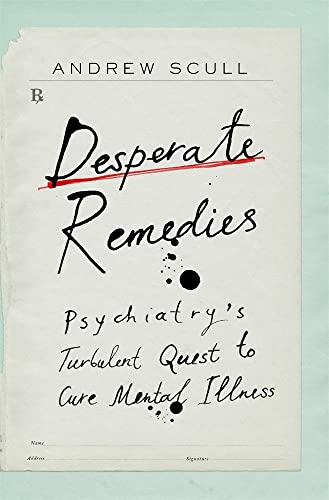
A sweeping history of American psychiatry―from the mental hospital to the brain lab―that reveals the devastating treatments doctors have inflicted on their patients (especially women) in the name of science and questions our massive reliance on meds. For more than two hundred years, disturbances of the mind―the sorts of things that were once called “madness”―have been studied and treated by the medical profession. Mental illness, some insist, is a disease like any other, whose origins can be identified and from which one can be cured. But is this true? In this masterful account of America’s quest to understand and treat everything from anxiety to psychosis, one of the most provocative thinkers writing about psychiatry today sheds light on its tumultuous past. Desperate Remedies brings together a galaxy of mind doctors working in and out of institutional settings: psychologists and psychoanalysts, neuroscientists, and cognitive behavioral therapists, social reformers and advocates of mental hygiene, as well as patients and their families desperate for relief. Andrew Scull begins with the birth of the asylum in the reformist zeal of the 1830s and carries us through to the latest drug trials and genetic studies. He carefully reconstructs the rise and fall of state-run mental hospitals to explain why so many of the mentally ill are now on the street and why so many of those whose bodies were experimented on were women. In his compelling closing chapters, he reveals how drug companies expanded their reach to treat a growing catalog of ills, leading to an epidemic of over-prescribing while deliberately concealing debilitating side effects. Carefully researched and compulsively readable, Desperate Remedies is a definitive account of America’s long battle with mental illness that challenges us to rethink our deepest assumptions about who we are and how we think and feel. Read more
There is no historian who has done more to identify, investigate, evaluate, and explain how civilized societies respond to those whose behaviors, emotions, personality, and affects distinguish them in ways large and small from the vast majority among whom they live than Professor Andrew Scull. A prolific historian and gifted writer, Professor Scull has produced a crowning masterpiece to an almost half-century career as one of the world's foremost historians of psychiatry. Desperate Remedies tells a markedly different and considerably more nuanced story than other works seeking to address the challenges posed by mental illness. As Scull makes clear, the history of psychiatry – both actual and metaphorical – has (and continues to be) largely a “stab in the dark.” Where hype, fashion, fantastical ideas, and crude metaphor (e.g., chemical imbalance) lay claim to the mantle of science absent virtually any supporting laboratory or clinical evidentiary foundation that is now the norm across other medical specialties. Where taxonomies based on … well … _______ (fill in the blank) have little more correspondence to (as yet) unknown biological or genomic entities than astrology does to our life’s course. None of this, of course, is surprising. In the face of the unknown and the uncertain, our species possesses a remarkable capacity to construct plausible but dubious explanations for virtually everything. But when those plausible but dubious explanations become the basis for both public policy and patient care, watch out! Whereas the majority of recent works that cover similar terrain are largely works of intellectual history – focusing on the contributions of medical elites – Scull never loses focus on the experience of patients (and victims) of these elite’s gone amuck. Those who had the teeth, tonsils, and colons removed based on the bogus notion that their aberrant emotional, behavioral, and affective traits were caused by focal infection. Or their frontal lobes sliced and diced via a procedure known as “prefrontal lobotomy” (i.e., an icepick through the eye socket) based on Egas Moniz’s Nobel prize winning procedure. Or an endless array of now discredited but once heralded procedures and interventions that left a trail of tears (and worse) in their wake. It is now more than 35 since the first prescription of an SSRI was filled in the United States. Since then, Americans have swallowed billions of these tablets and capsules. While simultaneously (and, in part, because of the relatively inexpensive cost to treat mental illness with drugs compared to more costly psychosocial interventions), the prospects of those with mental illness have declined precipitously over this same period. As Scull explains, “From the patient’s point of view, all these developments have occurred alongside the collapse of public psychiatry and the consignment of many of the mentally ill to the squalor of the streets and the terrors of American jails. For those retaining any lingering disposition to embrace a narrative of psychiatric progress, there is the brutal reality that those suffering from serious mental illness have a lifespan of 20 to 30 years less on average than the rest of us – and this is a mortality gap, moreover, that is increasing, not diminishing.” Scull’s assessment is hardly the screed of an anti-psychiatrist. A virtually identical cri de cour recently echoed from the nation's temple of institutional psychiatry. Describing what he accomplished during his 13-year tenure as “America’s psychiatrist” former National Institute of Mental Health (NIMH) Director, Thomas Insel said: “I succeeded in getting lots of really cool papers published by cool scientists at fairly large cost − I think $20 billion – [but] I don’t think we moved the needle in reducing suicide, reducing hospitalizations, improving recovery for the tens of millions of people who have mental illness.” To address this mounting mental healthcare crisis that transcends race, class, gender, and identities of all stripes, we need to radically reconceptualize how we respond to and address the needs of those suffering from mental illness. We also need to reconsider the centrality of pharmaceutical solutions to the exclusion of other psychosocial interventions. But to do so effectively, we need first to understand how we arrived at our current crisis. Which is why Professor Scull’s brilliant and timely book is must reading.
Publisher -> Belknap Press: An Imprint of Harvard University Press (May 17, 2022) Language -> English Hardcover -> 512 pages ISBN-10 -> 0674265106 ISBN-13 -> 978-0674265103 Item Weight -> 1.65 pounds Dimensions -> 6.1 x 1.2 x 8.7 inches Best Sellers Rank: #12,406 in Books (See Top 100 in Books) #4 in Medical Psychology History #4 in Popular Psychology History #5 in Schizophrenia (Books)
Get eBooks Desperate Remedies: Psychiatry’s Turbulent Quest to Cure Mental Illness
(Download PDF Books) Desperate Remedies: Psychiatry’s Turbulent Quest to Cure Mental Illness
*[G.e.t] M.O.B.I Desperate Remedies: Psychiatry’s Turbulent Quest to Cure Mental Illness /a>
(Download And Read) Desperate Remedies: Psychiatry’s Turbulent Quest to Cure Mental Illness
[Verenga] (Epub) Desperate Remedies: Psychiatry’s Turbulent Quest to Cure Mental Illness
Obtenir [eBooks] Desperate Remedies: Psychiatry’s Turbulent Quest to Cure Mental Illness


Comments
Post a Comment