🕤Obtain Our Unfinished March: The Violent Past and Imperiled Future of the Vote-A History, a Crisis, a Plan by Eric Holder
Our Unfinished March: The Violent Past and Imperiled Future of the Vote-A History, a Crisis, a Plan by Eric Holder
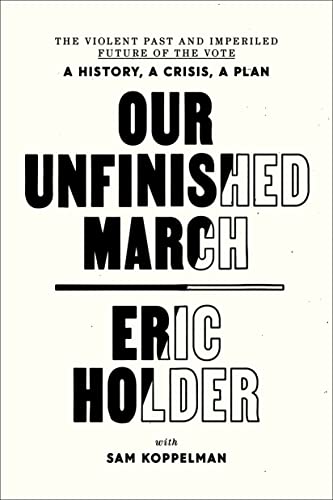
A brutal, bloody, and at times hopeful history of the vote; a primer on the opponents fighting to take it away; and a playbook for how we can save our democracy before it’s too late—from the former U.S. Attorney General on the front lines of this fight Voting is our most important right as Americans—“the right that protects all the others,” as Lyndon Johnson famously said when he signed the Voting Rights Act—but it’s also the one most violently contested throughout U.S. history. Since the gutting of the act in the landmark Shelby County v. Holder case in 2013, many states have passed laws restricting the vote. After the 2020 election, President Trump’s effort to overturn the vote has evolved into a slow-motion coup, with many Republicans launching an all-out assault on our democracy. The vote seems to be in unprecedented peril. But the peril is not at all unprecedented. America is a fragile democracy, Eric Holder argues, whose citizens have only had unfettered access to the ballot since the 1960s. He takes readers through three dramatic stories of how the vote was won: first by white men, through violence and insurrection; then by white women, through protests and mass imprisonments; and finally by African Americans, in the face of lynchings and terrorism. Next, he dives into how the vote has been stripped away since Shelby —a case in which Holder was one of the parties. He ends with visionary chapters on how we can reverse this tide of voter suppression and become a true democracy where every voice is heard and every vote is counted. Full of surprising history, intensive analysis, and actionable plans for the future, this is a powerful primer on our most urgent political struggle from one of the country's leading advocates. Read more
We would all do well to remember that the United States was not founded as a democracy, not by any stretch of the imagination. It’s not just that African Americans, Native Americans, and women were denied the vote; white males even discriminated against each other, denying the franchise to those without the necessary property qualifications. What all this amounted to is that, when George Washington first ran for president, only one out of every 16 people, or 6 percent of the entire population, could vote. Rich white men, in other words, were the only ones with political or economic power, meaning that, essentially, the founders threw off monarchy only to replace it with an aristocracy steeped in misogyny and white supremacy. The founders didn’t get everything wrong, though. They deserve credit for creating the first secular constitution the world had ever seen, and the encoding of the separation of church and state into the Constitution is probably the greatest gift they gave us. Further, the Declaration enshrined the ideals that, if they were not possible to live by at the time, would provide the foundation for continual moral improvement. So it’s important to avoid adopting extreme positions, either that the country is perfect and faultless or that it is inherently evil and unjust (one of the left’s biggest mistakes is ceding over patriotism to the right). It is a mix of both the good and the ugly, and we must take an honest look at our past to chart a better future. (For the best single-volume history of the US that takes this middle-ground approach, check out Jill Lepore’s masterpiece of a book, These Truths: A History of the US.) Of course, there’s no question that the founders could have made it a lot easier for us. They could have replaced the phrase “all men are created equal” with “all men and women of any race or color are created equal.” But they didn’t—probably because they knew no one at the time would actually believe it—with the result that rampant discrimination would continue to take place. US history is certainly a history full of contradictions. The country was founded on the phrase “all men are created equal” and yet simultaneously condoned slavery. It fought against the injustice of “taxation without representation” and then went on to tax half the population (women) without granting them the vote until 1920 (1920!!). Literally every bit of moral progress that has been made in this country has come at the cost of intense struggle, sacrifice, bloodshed, and resistance from bigots, with a lesson we should all remember: Just because progress is made, doesn’t mean that it can’t be taken away. And that’s why this book is important. As Holder reminds us, the moral arc does not necessarily and automatically bend towards justice—we have to fight for it. The right to vote—the most obvious and basic right imaginable in a democracy (in this case a representative democracy)— has always been under attack from the individuals that stand to benefit from its suppression. So when Republicans employ tactics to suppress the vote in response to imaginary “voter fraud” issues—and clearly benefit electorally from doing so—you’d have to be pretty naive to not recognize what’s really going on. (Also note that an independent study from The Brennan Center, a nonpartisan law and policy institute, calculated that, statistically, you have a greater chance of being struck by lightning than committing voter fraud. Voter fraud is exceedingly rare, and if it ever does happen, it’s not swinging any elections, ever. High voter turnout favors Democrats because—in math even the most hard-headed conspiracy theorist could understand—more of the population identifies as Democrat or Democratic-leaning than Republican.) This explains why, in the aftermath of the midterm elections during the Obama presidency, Republicans introduced almost 200 bills across 41 states making it harder to vote. What you have is a party that knows it can’t win when everyone votes, and so its top priority is voter suppression. But it can’t come out and say this, and so it has to introduce these bills under the guise of protection against “voter fraud.” And it works, because people believe it. Holder does a phenomenal job of explaining all of this. In the first part of the book, he outlines the history of vote suppression and how African Americans and women eventually won the vote. In the second part, he describes the current conservative strategy to suppress minority voting (which benefits Republicans) through discriminatory state laws and to skew representation through the most anti-democratic process imaginable: gerrymandering. Holder reminds us that the Republican attack on the vote, and thus on democracy, is not surprising. Their policies no longer match the needs and preferences of most of the population, and so vote suppression and gerrymandering are literally the only means by which they can think to hold onto power. What is surprising is that we’re allowing it to happen. And that brings us to the final part of the book, where Holder outlines the plan to stop the madness and restore our democracy before irreparable damage is done. In summary, here’s what Holder suggests we do to fix our democracy. First and foremost, we should make it easier to vote with automatic voter registration, early voting, free voter IDs, and making election day a national holiday. What’s interesting is that automatic voter registration (AVR) would also work to prevent voter fraud, so if Republicans really cared about that, they should support AVR. Big surprise—they don’t. We should recognize that while making voting easier does benefit Democrats, we should want to do this even if it did the opposite. If we really want a democracy, we have to respect the wishes of the majority, and if the majority wants Republican policies enacted, that is what should happen (as Holder acknowledges). Otherwise, you have an oligarchy, and even if you favor the current policies now, this won’t always be the case. It’s a dangerous scenario when a country has no means to remove dangerous or corrupt leaders, and without the vote, it becomes near impossible to do so. Second, we need to fix Congress. The Senate is, first of all, in direct violation of the one-person one-vote ideal. The population of Wyoming, for example, is about 600,000. The population of California is almost 40 million. Yet both states get two senators. Something doesn’t seem right about that, and, in fact, we probably don’t need the Senate at all. We should keep in mind what Todd Tucker from the Roosevelt Institute said: “Roughly half of the world’s countries, including highly economically successful nations, such as Denmark, Iceland, Israel, New Zealand, Norway, and Sweden, have only one chamber—elected generally on a one-person, one-vote basis. Others—including the UK, Canada, and Germany—have unelected second chambers that are much weaker than the U.S. Senate and perform functions that in relative terms appear mostly advisory….only the second chambers of Brazil, Argentina, and Russia are less evenly represented than the United States” This is not great company to be in. And it’s even worse than that; with the filibuster, most bills require a supermajority to pass, with the unsurprising result that Congress never gets anything valuable accomplished. The obvious solution: at the least, eliminate the filibuster (which was never part of the Constitution). The argument for the filibuster was never a good one anyway. As Holder writes: “If Democrats eliminate the filibuster; expand access to the franchise; provide statehood to Washington, D.C., and Puerto Rico; and still manage to lose control of the presidency and Congress to Republicans, then that is at least in part a reflection of the will of the people—and Republicans should be allowed to enact their agenda, without the added burden of needing a supermajority in the Senate. Because that’s how democracy works. And if voters don’t like what the party in power does, then they can show up in the polls, vote them out, and start passing legislation with a Senate majority of their own.” We know the Senate is largely unrepresentative of the population, as this is built into the Constitution. But the House of Representatives was never supposed to be this way. Thanks to gerrymandering (or partisan redistricting), however, the House is not representative either. As Holder writes: “In 2012, after that gerrymandering, Democrats won 1.4 million more votes than Republicans in races for the U.S. House of Representatives, but Republicans engineered a thirty-three seat majority.” Again, we have to decide: do we want a democracy or not? Because if we continue to allow partisan redistricting (rather than nonpartisan commissions carrying out the duty), then we willingly allow our politicians to pick their voters rather than the other way around. Between voter suppression, unequal representation in the Senate, and gerrymandering in the House, Congress unequivocally does not represent the interests of the majority, and it’s not even close. We need to make voting easier and end the filibuster and gerrymandering. There are simply no compelling arguments not to (other than short-term partisan victories at the expense of the long-term viability of our democracy). Holder’s final two recommendations include eliminating the Electoral College (which can allow a candidate to win the presidency without winning the popular vote) and expanding the size of the Supreme Court while eliminating lifetime appointments. All good ideas. Whether they will ever actually happen is another story. I have to say that, in a book on voting, I’m surprised that ranked-choice voting was not mentioned once. Without ranked-choice voting, people often cannot vote for their preferred candidate without feeling like they’re voting against their own party. This surely compels many people—faced with a vote between two lackluster candidates—to skip out on election day entirely. Ranked-choice voting eliminates this issue, allowing people to vote for whoever they want without throwing out their vote on longshot candidates. In a book that wants to encourage high voter turnout, this is a missed opportunity for the advocacy of an important policy. Holder also mentions that one of the advantages of eliminating the Electoral College is that candidates would have to appeal to a larger group of people, forcing them to adopt less extreme positions. Ranked-choice voting would have a similar effect, and so is every bit as important in tempering polarization. Overall, if you stop to think about it, the US is a pretty poor excuse for a democracy. Our government simply does not represent the majority. The Senate over-represents smaller states by a massive margin; the House (along with state legislatures), through gerrymandering, over-represents Republican voters; the Electoral College often grants the presidency to the candidate that lost the popular vote; and the Supreme Court consists of nine justices that are appointed for life by whatever president happens to be in office when a replacement is needed, leading, in some cases, to laws being gutted by unelected partisan judges. If you don’t see all this as a problem, and one predominantly coming from the right, then you’re not paying very close attention—or else democracy is not what you’re really after.
Publisher -> One World (May 10, 2022) Language -> English Hardcover -> 304 pages ISBN-10 -> 0593445740 ISBN-13 -> 978-0593445747 Item Weight -> 14.6 ounces Dimensions -> 5.66 x 1.03 x 8.53 inches Best Sellers Rank: #13,029 in Books (See Top 100 in Books) #21 in Elections #22 in Civics & Citizenship (Books) #29 in Democracy (Books)


Comments
Post a Comment